Warm, Worn, and Irreplaceable: Why the Swampers' Tape Machines Still Beat Every Plugin on the Market
Pull up any of the classic Muscle Shoals recordings — Aretha Franklin's "I Never Loved a Man (The Way I Love You)," Wilson Pickett's "Land of 1000 Dances," the Rolling Stones cutting loose on "Wild Horses" — and you'll notice something that's hard to name but impossible to ignore. The sound has weight to it. Texture. A kind of breathing quality, like the music is actually alive in the room with you. That's not an accident, and it's not just good playing. A significant part of what you're hearing is the direct result of how those recordings were made — on analog tape, through vintage consoles, in a room with specific acoustic quirks that nobody planned but everybody benefited from.
Decades later, producers are still chasing that quality. And the more they chase it, the more they realize how much of it came down to the specific, unglamorous, deeply physical process of recording to magnetic tape in a converted building in northwest Alabama.
What Tape Actually Does to Sound
To understand why the Muscle Shoals recordings hit differently, you have to understand what happens when sound gets committed to analog tape. It's not a clean, neutral process. Magnetic tape physically saturates — meaning when a signal gets loud enough, the tape starts to compress and distort in a way that's sonically pleasing rather than harsh. The technical term is "harmonic distortion," but what it actually sounds like is warmth. Roundness. A natural limiting effect that keeps loud transients from feeling brittle or cold.
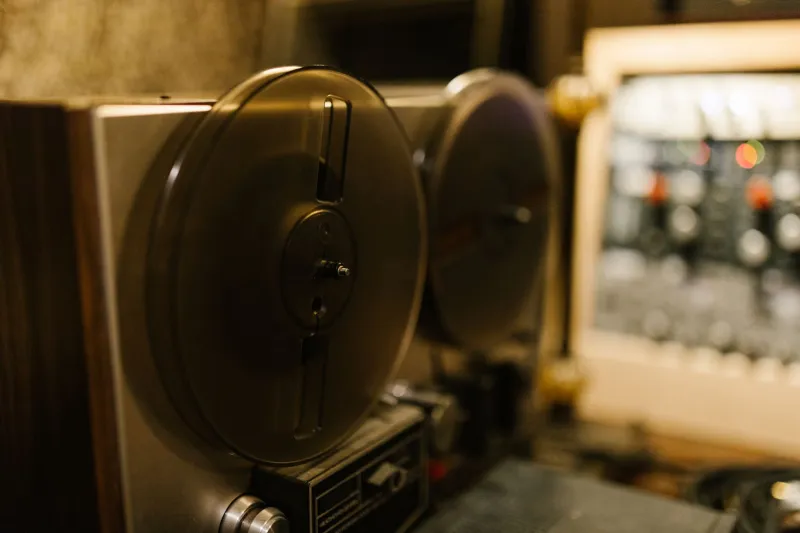
The Ampex and Scully tape machines that populated both FAME Studios and the original Muscle Shoals Sound Studio on Jackson Highway weren't just recording devices. They were active participants in shaping the sound. Every pass through those machines added a subtle layer of saturation. Every bounce between tracks introduced a tiny amount of noise — the kind of noise that, paradoxically, makes a recording feel more human and less clinical.
Modern recording engineers sometimes spend thousands of dollars on hardware tape emulation units or high-end plugins specifically to recreate this effect. Some of them get close. None of them get all the way there, and most working producers will admit that in a blind listening test, the real thing still wins.
The Console as an Instrument
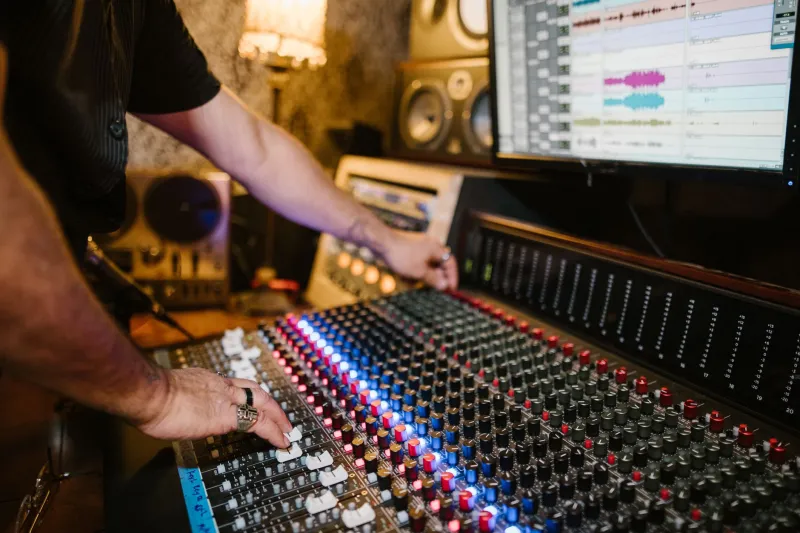
The mixing boards at Muscle Shoals were not neutral tools. The early API and later SSL-adjacent consoles used in the studios had their own sonic personalities — coloration baked into the preamps, the transformers, the EQ circuits. When Jimmy Johnson or Barry Beckett pushed a fader or added a touch of top-end on a vocal, they weren't just adjusting a parameter. They were running the signal through circuitry that added its own harmonic content, its own subtle compression, its own character.
This is why a lot of engineers who have worked extensively with vintage gear describe it in almost anthropomorphic terms. The board had opinions. It pushed back. It contributed. A modern digital console, even a very expensive one, is designed to be as transparent as possible — to get out of the way of the signal. The old Muscle Shoals gear was never out of the way. It was always in the conversation.
That constant, low-level "conversation" between the musicians, the room, and the equipment is a big part of why those recordings feel so alive. There were no perfectly flat frequency responses. There were no pristine, uncolored signal chains. Everything was slightly imperfect in ways that, stacked together, added up to something extraordinary.
The Room Itself Had a Sound
The original Muscle Shoals Sound Studio at 3614 Jackson Highway was a converted coffin factory — which, depending on your sense of humor, either explains everything or explains nothing. What it actually provided was a set of acoustic properties that nobody specifically engineered but that turned out to be ideal for the kind of music being made there.
The ceilings were low enough to create a certain intimacy. The walls had enough irregular surfaces to diffuse sound without killing it entirely. The isolation between the live room and the control room was imperfect in ways that let a little bleed through, which meant that what you heard on tape wasn't just the isolated signals from individual microphones — it was the sound of a band playing together in a real space, bleeding into each other's microphones in real time.
That bleed is something digital recording has largely eliminated. Modern studios use extreme isolation to keep tracks clean and editable. What they lose in the process is the way instruments interact acoustically — the way a kick drum resonates inside a bass guitar, the way a piano's overtones drift into a vocal microphone and add a subtle shimmer. The Muscle Shoals recordings are full of that kind of accidental interaction, and it's a huge part of why they feel so cohesive and organic.
Why Digital Gets the Notes But Misses the Feeling
Here's the thing about digital recording: it is, by most objective measures, more accurate than analog tape. It captures a wider frequency range. It has a lower noise floor. It doesn't degrade with repeated playback. If you're trying to make a perfect technical copy of a sound, digital wins.
But music isn't really about technical perfection. It's about emotional response. And this is where the conversation gets interesting, because researchers studying psychoacoustics — the science of how humans perceive sound — have found that the very "imperfections" of analog tape recording tend to trigger stronger emotional responses in listeners. The harmonic distortion introduced by tape saturation adds overtones that are mathematically related to the original signal in ways that the human auditory system finds pleasing. The gentle compression smooths out dynamics in a way that feels natural rather than processed. The slight wow and flutter of a tape machine adds micro-variations in pitch and timing that, at very low levels, make a recording feel more like a live performance.
None of this was something the Swampers sat down and calculated. They were just using the tools they had, in the room they had, trying to get the best possible sound out of the sessions they were running. But the cumulative effect of all those analog choices was a body of recordings that have held up emotionally for more than half a century — and that continue to move people in ways that a lot of more technically sophisticated modern recordings simply don't.
The Lesson That's Still Being Learned
The revival of interest in analog recording over the past decade or so is, in a real sense, a long-overdue acknowledgment that the Swampers were onto something. Studios that mothballed their tape machines in the '90s are pulling them back out. Artists who grew up entirely in the digital era are booking time in studios specifically because they have vintage gear. Plugins with names like "Tape" and "Saturator" are among the most downloaded in the industry.
All of it is chasing the same thing: that quality in the old Muscle Shoals recordings that makes you feel like you're hearing something real. Something that happened in a room, between people, filtered through machines that had their own voices.
The technology was never the whole story at Muscle Shoals — the players, the chemistry, the songs all mattered enormously. But the gear mattered too. The tape mattered. The room mattered. And the fact that we're still talking about it, still trying to recreate it, still falling a little short every time, is probably the most honest tribute the industry could pay to what happened in that converted coffin factory on Jackson Highway.